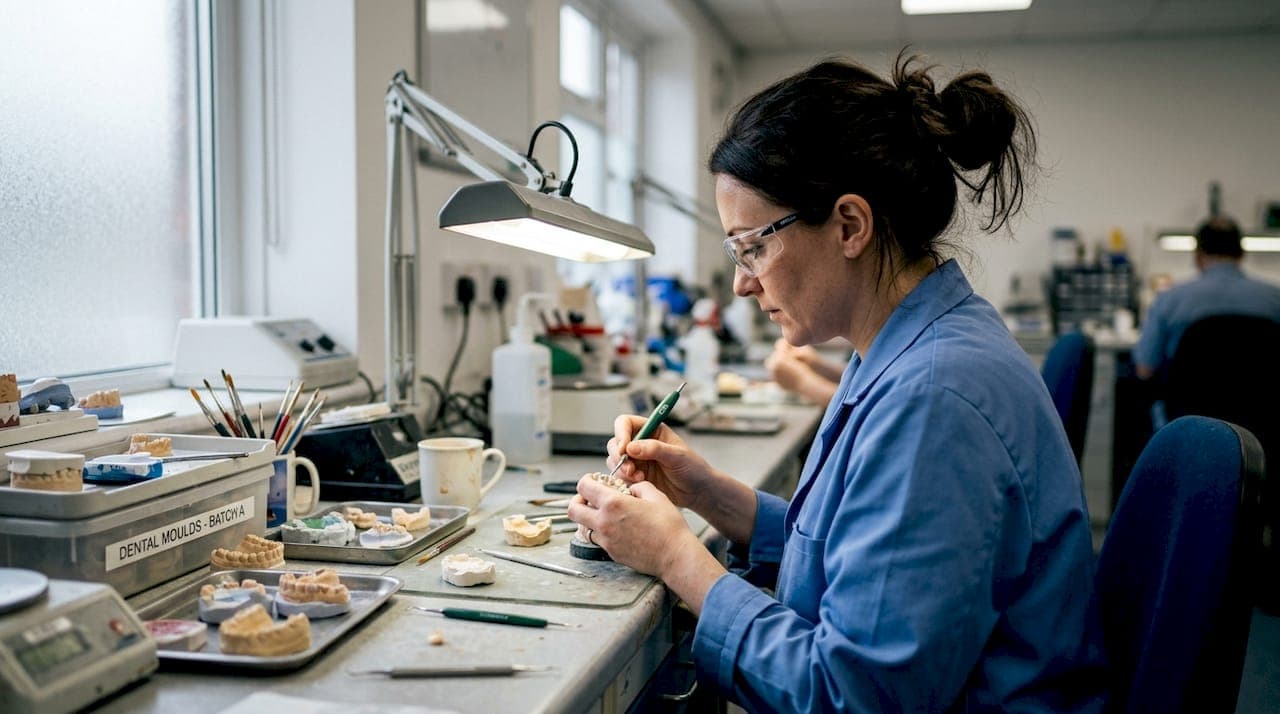
The outcome of your dental treatment depends on far more than your dentist's skill alone. Behind every crown, bridge, denture, or implant sits an unseen world of precision craftsmanship: the dental lab. Most patients never think about it, yet the quality of work produced there directly shapes how well your restoration fits, functions, and lasts. For anyone considering dental tourism, this matters even more. Lab standards vary enormously between countries and clinics, and understanding what separates a reliable lab from a risky one could save you thousands of pounds and considerable discomfort.
Table of Contents
- What is a dental lab and why does it matter?
- Inside the dental lab: How custom prosthetics are made
- Comparing traditional and digital dental lab methods
- Certification, quality standards, and dental tourism risks
- Why lab quality matters more than price: A practical perspective for dental tourists
- Explore safe and certified dental care options
- Frequently asked questions
Key Takeaways
| Point | Details |
|---|---|
| Dental labs matter | The precision and quality of dental lab work directly impact your treatment outcome and satisfaction. |
| Digital equals accuracy | Modern CAD/CAM labs offer superior fit and faster turnaround compared to traditional methods. |
| Certification is safety | Always check lab certifications and traceability before undergoing dental work abroad for peace of mind. |
| Price versus quality | Choosing cheaper, uncertified labs may result in costly complications—prioritise quality to avoid problems. |
What is a dental lab and why does it matter?
A dental lab is not simply a workshop. As defined by industry specialists, a dental lab is a specialised facility where trained technicians fabricate custom dental prosthetics and appliances such as crowns, bridges, dentures, veneers, and orthodontic devices based on dentists' prescriptions, impressions, or digital scans. Every item is made specifically for one patient. Nothing is off the shelf.
The technicians working inside these labs undergo years of specialist training. They must understand dental anatomy, materials science, and the mechanical forces your teeth endure every day. A poorly designed crown can crack under chewing pressure. An ill-fitting denture can cause sore spots and bone loss over time. These are not minor inconveniences; they are clinical failures.
The range of appliances produced by dental labs includes:
- Crowns and bridges: Tooth-shaped caps or spans that restore damaged or missing teeth
- Dentures: Full or partial removable replacements for missing teeth
- Veneers: Thin porcelain shells bonded to the front of teeth for aesthetics
- Implant components: Custom abutments and prosthetic crowns fixed to titanium implants
- Orthodontic devices: Retainers, aligners, and functional appliances
The lab's role in customisation is central to treatment success. Your dentist takes an impression or digital scan of your mouth and sends it to the lab with precise instructions. The technician then builds a restoration that must match your bite, your adjacent teeth, and your gum line with extraordinary accuracy. Dental labs ensure precise fit, aesthetics, function, and biocompatibility using certified materials, and poor lab work leads to remakes, adjustments, and outright failures.
If you want to understand how dental crowns are made or learn more about exploring custom dentures, the lab process is at the heart of both. Choosing a clinic that works with a reputable, certified lab is not optional; it is essential.
Inside the dental lab: How custom prosthetics are made
Knowing what a dental lab does is one thing. Understanding how it does it reveals why quality varies so dramatically between providers.
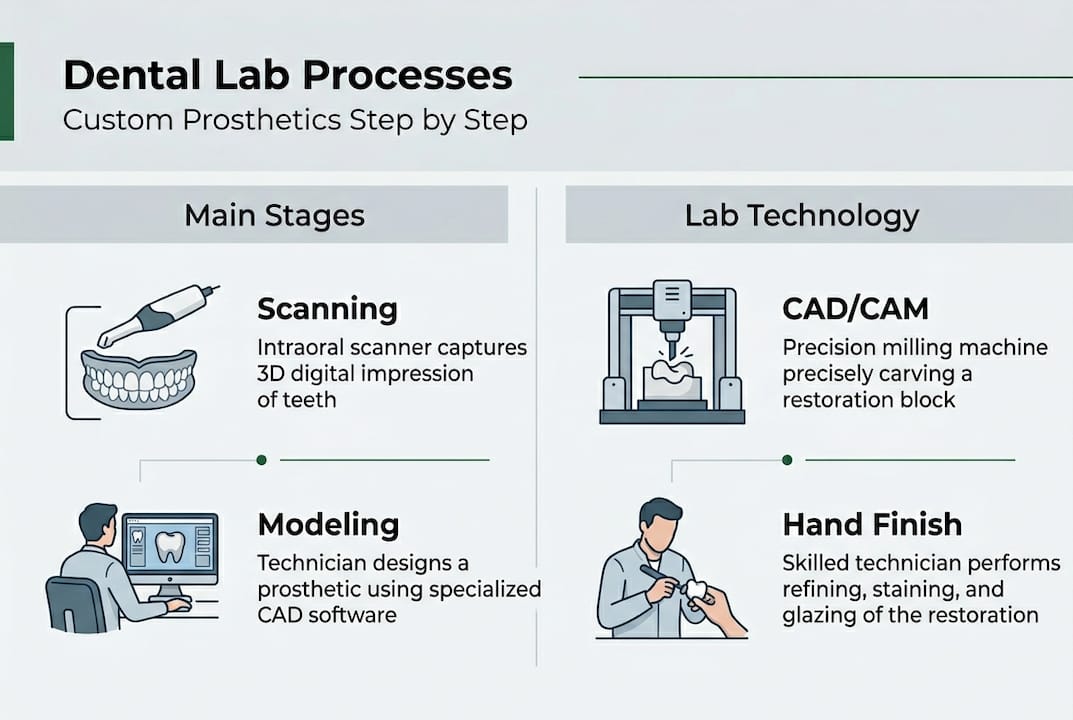
The journey from your dentist's chair to a finished restoration follows a clear sequence. Dental lab processes involve receiving impressions or digital scans, creating models (stone or 3D printed), designing via CAD software, milling or casting frameworks, layering materials like porcelain or zirconia, sintering or firing in furnaces at precise temperatures, finishing with staining, glazing, and polishing, and finally performing quality checks for fit, occlusion, and marginal integrity under 120 microns.
To put that in practical steps:
- Impression or scan received: The lab receives either a physical impression or a digital scan file from the dentist.
- Model creation: A physical or 3D-printed model of your teeth is produced to serve as the working reference.
- Design phase: Using CAD (computer-aided design) software, the technician designs the restoration to match your anatomy precisely.
- Milling or casting: The framework is either milled from a solid block of material (zirconia, for example) or cast using traditional metal techniques.
- Layering and colouring: Porcelain or ceramic layers are applied and colour-matched to your natural teeth.
- Firing and sintering: Materials are hardened in high-temperature furnaces to achieve final strength.
- Finishing and quality check: The restoration is polished, glazed, and inspected for fit, bite alignment, and marginal seal.
The tolerance demanded at the marginal fit (where the crown meets the tooth) must be under 120 microns. To put that in perspective, a human hair is roughly 70 microns wide. This level of precision is not achievable without proper equipment, skilled technicians, and rigorous quality control.
| Stage | Technology used | Key quality measure |
|---|---|---|
| Scanning | Intraoral scanner or impression | Dimensional accuracy |
| Design | CAD software | Anatomical precision |
| Milling | 5-axis CNC mill | Marginal fit under 120 microns |
| Sintering | High-temperature furnace | Material density and strength |
| Finishing | Hand tools and polishing | Aesthetics and surface texture |
Pro Tip: When consulting a clinic abroad, ask specifically whether they use in-house CAD/CAM milling or outsource to a third-party lab. In-house labs allow faster corrections and tighter quality control.
For patients considering making dental bridges, understanding this workflow helps you ask the right questions before treatment begins.
Comparing traditional and digital dental lab methods
Dental labs have not always looked like they do today. For decades, the dominant method involved wax-ups (hand-sculpted wax models), lost-wax casting, and entirely manual finishing. These techniques produced good results in skilled hands, but they were slow, and accuracy depended heavily on individual craftsmanship.
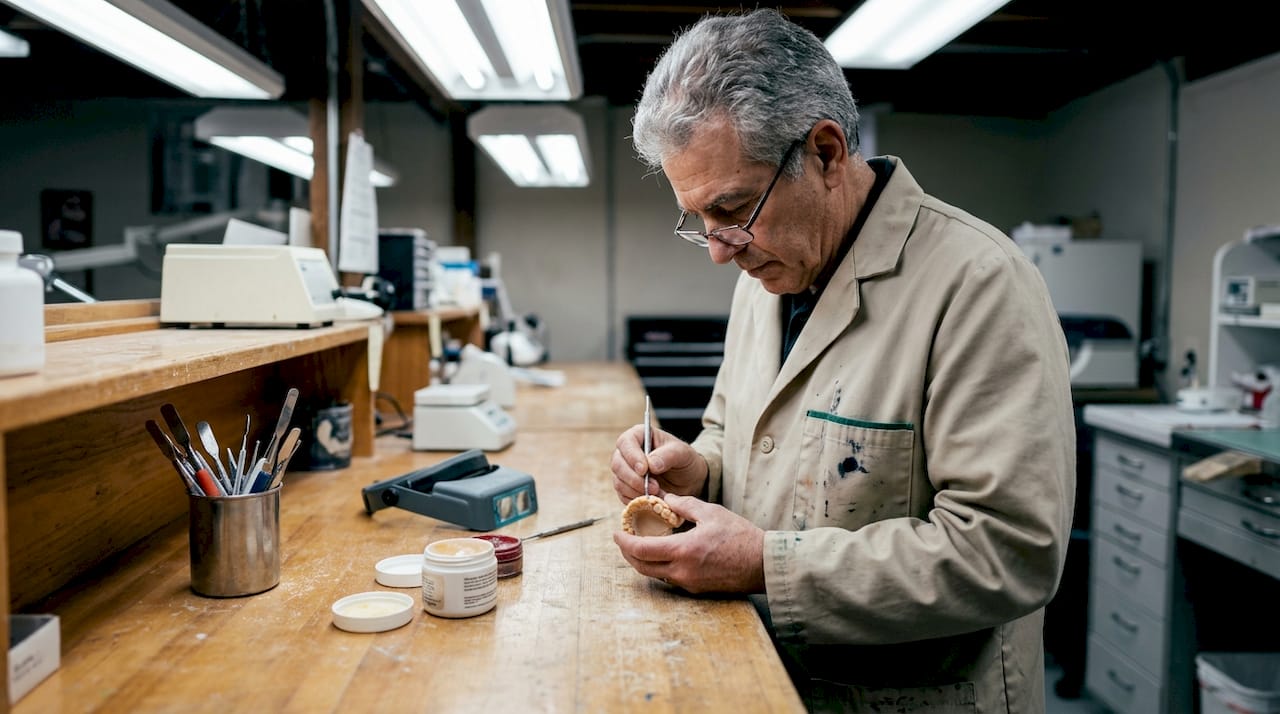
The shift to digital has changed everything. Modern labs use CAD/CAM for precision at 10 to 50 micron accuracy with 5-axis milling, transitioning from traditional wax-ups to digital workflows and reducing errors and turnaround to 5 to 10 days.
| Feature | Traditional method | Digital (CAD/CAM) method |
|---|---|---|
| Accuracy | 50 to 200 microns (variable) | 10 to 50 microns (consistent) |
| Turnaround time | 10 to 21 days | 5 to 10 days |
| Error rate | Higher (manual steps) | Lower (automated design) |
| Material range | Metal, porcelain-fused-to-metal | Zirconia, lithium disilicate, PMMA |
| Remake risk | Moderate to high | Low with certified labs |
Digital methods also introduce new material requirements. Zirconia, for example, must be sintered at temperatures above 1,400°C in calibrated furnaces. If a lab lacks this equipment or skips calibration checks, the material may be under-sintered and structurally weak, even if it looks fine on the surface.
The risks associated with uncertified or offshore labs include:
- Inconsistent material quality: Unverified suppliers may use substandard ceramics or metals
- Poor marginal fit: Leading to bacterial infiltration and decay beneath the restoration
- Logistical delays: Offshore labs add shipping time, complicating adjustments
- No traceability: If something fails, there is no documentation trail to investigate
For patients researching risks of low-quality labs, the data is stark. Remake rates at uncertified labs run significantly higher, and each remake adds cost, time, and clinical risk.
Certification, quality standards, and dental tourism risks
Certification is the clearest signal of lab quality. It is not marketing language; it is documented evidence that a lab follows verified processes, uses traceable materials, and submits to independent audits.
Key certifications to look for include:
- ISO 13485: International standard for medical device quality management systems
- ISO 9001: General quality management standard covering processes and consistency
- CE marking: Confirms compliance with European safety and performance standards
- FDA registration: Required for labs supplying the US market; signals rigorous oversight
- CDL (Certified Dental Laboratory): A professional accreditation specific to dental labs
Labs must have certifications like ISO 13485, CE or FDA to ensure quality and avoid risks; uncertified labs risk substandard materials, poor fit with remake rates of 8 to 15%, and legal complications. Always verify whether the lab is in-house or outsourced, and request documentation of material traceability.
For dental tourists, the stakes are higher still. Complex implants require custom abutments and surgical guides, and risks in tourism include rushed treatment plans and low-quality labs causing complications. Research indicates that 86% of UK dentists manage dental tourism failures, with repair costs frequently exceeding £500.
Patient reminder: Before committing to treatment abroad, ask your clinic directly: "Which lab produces your prosthetics, and can you share their certification documents?" A reputable clinic will answer without hesitation.
Pro Tip: Request a written record of the lab's name, location, and certification numbers before signing any treatment agreement. This protects you legally and clinically if problems arise later.
Patients considering implant lab procedures should pay particular attention to abutment sourcing and sintering quality, as these directly affect long-term implant survival rates.
Why lab quality matters more than price: A practical perspective for dental tourists
There is a persistent myth in dental tourism: that saving money on treatment automatically means good value. It does not. The real cost calculation must include the probability of failure, the cost of remediation, and the burden placed on your home NHS or private dentist when things go wrong.
High-quality labs with ISO, CE, or FDA certification reduce remake risks and ensure longevity, with implant survival rates of 95 to 98%. For tourism patients, prioritising labs with documented processes over cost avoids post-treatment NHS burdens that can dwarf the original saving.
We have seen patients arrive having paid a fraction of UK prices abroad, only to require full retreatment within two years. The restoration looked acceptable initially, but the marginal fit was poor, decay developed beneath the crown, and the implant abutment was not correctly torqued. Every one of these failures traced back to lab quality, not the dentist's technique.
The practical steps for assessing lab quality before you travel are straightforward: ask for the lab's certification, confirm whether it is in-house or outsourced, request before-and-after cases from that specific lab, and check whether the clinic offers any guarantee tied to lab-related failures. Clinics that work with certified labs are proud of it. Those that deflect the question are telling you something important. You can read more about tourism failures and costs to understand the full financial picture before making any decisions.
Explore safe and certified dental care options
If this guide has clarified one thing, it is that the lab behind your treatment matters as much as the clinic in front of you.
At Cronos Dental, all prosthetics and implant components are produced in facilities meeting ISO and CE standards, with full material traceability on every case. Whether you are considering crowns, bridges, dentures, or implants, you deserve to know exactly where your restoration comes from and how it was made. Browse the full range of Cronos Dental treatment options or explore specific information on crowns and custom prosthetics to see how certified lab processes support lasting results. Our team is available for transparent consultations with no obligation.
Frequently asked questions
How do dental labs ensure the fit and longevity of crowns or dentures?
Dental labs use precise measurements, CAD/CAM technology, and thorough quality checks to ensure a snug fit and durable prosthetics. Accuracy checks for fit target marginal integrity under 120 microns, which is critical for long-term success.
What certifications should I look for in a dental lab abroad?
You should look for labs certified to ISO 13485, ISO 9001, CE or FDA standards and ask about traceability of custom devices. Labs with ISO 13485 and CE or FDA certification demonstrate verified quality management and material safety.
Is it safe to use offshore dental labs to save money?
Offshore labs may offer lower prices, but certified labs reduce the risk of remakes and complications that could nullify any savings. Offshore labs cut costs but higher remakes and logistics erode those savings when complications arise.
What happens if a dental appliance does not fit properly?
Poorly fitting appliances may require remakes or adjustments and could cause complications, inconvenience, and extra costs. Poor lab work leads to remakes, adjustments, and clinical failures that affect both comfort and long-term oral health.